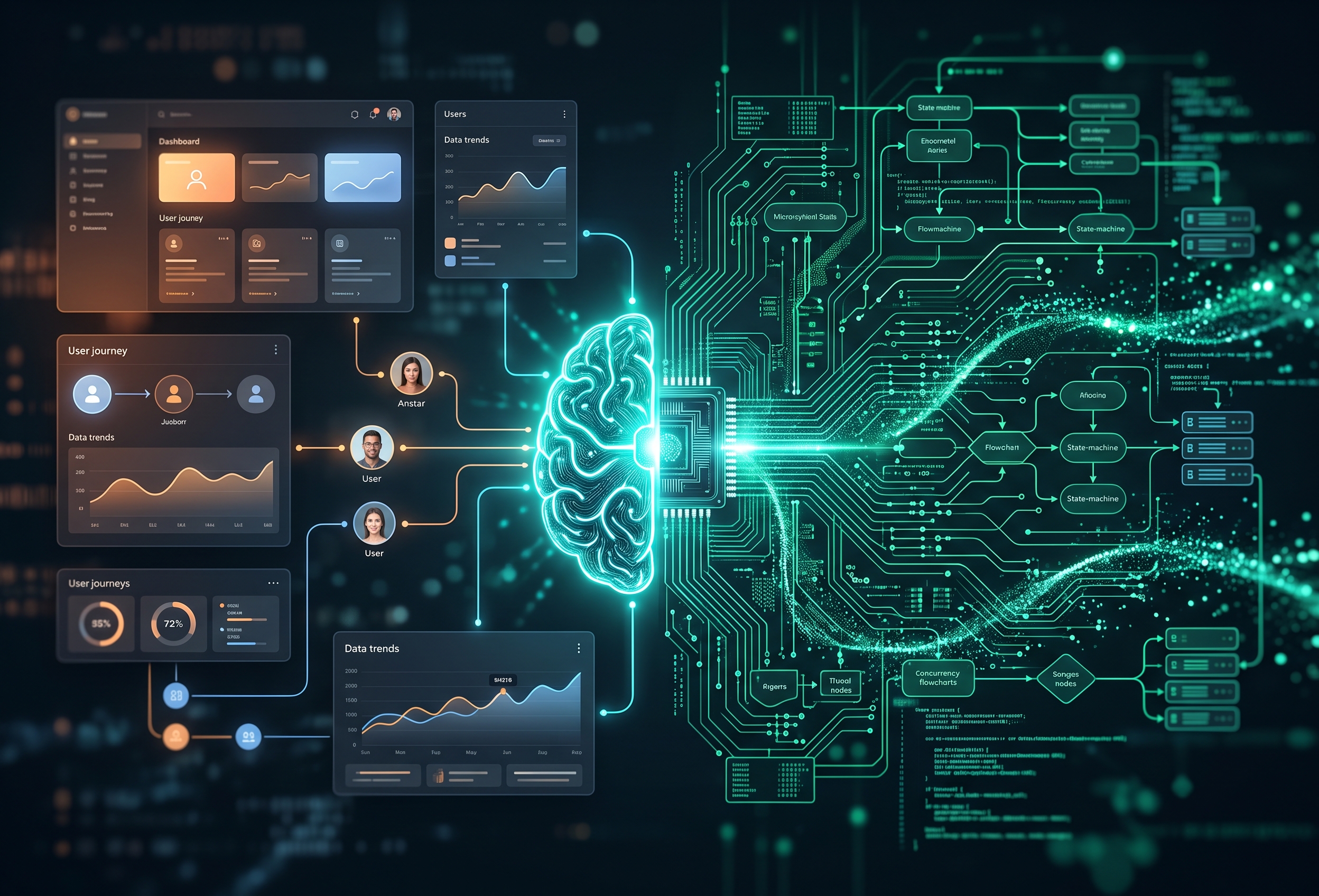
Product-Led Growth (PLG) has long relied on static onboarding wizards, checklist modules, and generic templates to guide users to their first activation milestone. While this reduces human sales barriers, it frequently fails users who have highly complex, custom workflows.
In the age of AI, the self-serve funnel is shifting from static pathways to personal, cognitive onboarding engines.
1. Personalized Cognitive Onboarding
Traditional self-serve funnels force users to parse documentation or configure dashboards manually. AI-driven onboarding flips this paradigm:
- Natural Language Configuration: Instead of filling out multi-step configuration forms, users detail their platform stack or business parameters in a single prompt.
- Dynamic Template Generation: The product dynamically scaffolds custom dashboards, database tables, and workflow configurations customized specifically to that prompt, dropping the Time-to-Value (TTV) to seconds.
2. Context-Aware In-App Guidance
Generic tooltips are frequently dismissed. AI allows for micro-assistance that acts exactly when a user experiences friction.
- Behavioral Triggering: AI agents detect when a user gets stuck on a complex configuration screen (such as writing database rules or mapping API paths) and offer context-aware code suggestions or fixes.
- Asynchronous Troubleshooting: Instead of opening support tickets or waiting for sales reps, users debug issues instantly inside the interface.
3. Protecting Unit Margins in AI PLG
Adding AI models into your self-serve funnel introduces API serving costs (token costs). If unchecked, this violates unit economic efficiency.
- Optimize Prompt Caching: Use edge-cached semantic models to answer common configuration questions, saving expensive model calls.
- Leverage Smaller Fine-Tuned Models: Utilize lightweight, fine-tuned models for specific layout generation tasks rather than calling heavy LLMs.