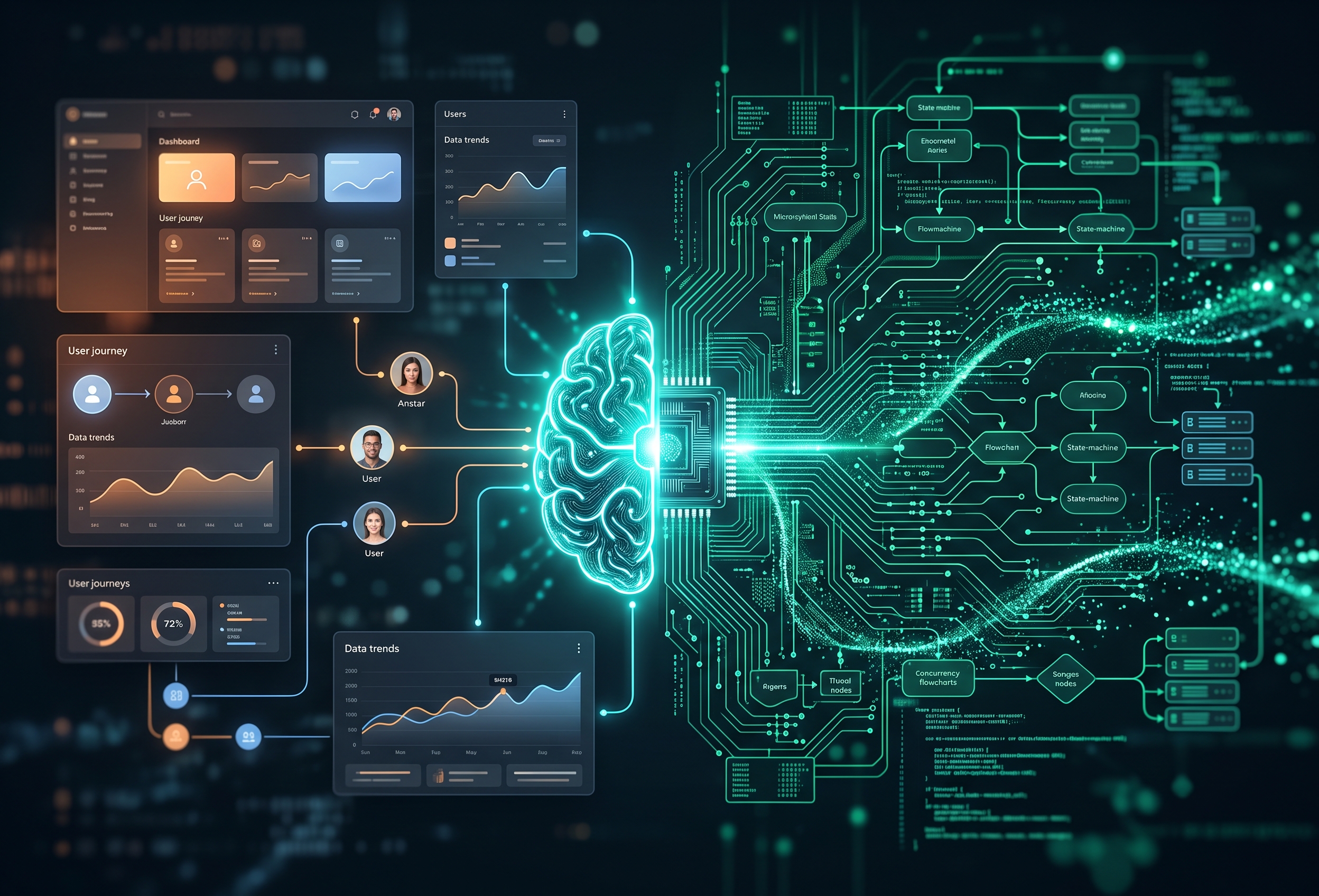
Most business automation today is still built around human biological constraints: dashboards designed for human eyes, notifications timed for human working hours, and multi-step approval gates meant to handle human distraction.
When engineering teams plug autonomous LLM agents into these legacy automations, performance degrades. Costs spike, context windows overflow, and workflows deadlock.
Optimizing workflows for autonomous AI agents requires fundamentally different architectural assumptions than optimizing for human workers.
1. Ergonomics vs. Tokenomics: UI vs. Machine-Readable State
| Dimension | Optimized for Humans | Optimized for AI Agents |
|---|---|---|
| Interface | Visual GUIs, dashboards, button hierarchies | Scoped JSON payloads, typed schemas, headless APIs |
| Information Density | Visual layout, color-coding, contextual cues | Token efficiency, high signal-to-noise text data |
| Error Handling | Modal alerts, descriptive toast messages | Explicit error codes, tracebacks, suggested recovery actions |
| Throughput Model | Serial tasks with micro-breaks | High-concurrency parallel tool execution |
Humans need whitespace, visual hierarchy, and contextual richness to process information without fatigue. Agents need extreme token economy.
When an automation sends an agent a bloated 15KB JSON dump or forces it to browse a web page via headless browser, it burns budget and context window capacity. Automations built for agents provide minimal, highly deterministic payloads—stripping out formatting fluff and exposing strict schemas.
2. The Core Shifts in Agent-First Automation
From "User Journeys" to "State Machine Primitives"
Human processes follow procedural checklists (SOPs). If a step fails, a human uses intuition to pivot.
An agent navigates via a state machine:
- Current state: What inputs exist in memory?
- Available actions (Tools): What explicit operations can change the state?
- Validation condition: Did the state update match the goal?
If an API returns a generic 400 Bad Request, a human reads the documentation. An agent gets stuck in a retry loop. Agent-optimized automations return corrective metadata (e.g., {"error": "invalid_date_format", "expected": "YYYY-MM-DD"}) so the agent can self-correct within its reasoning loop.
Dynamic Scoping Instead of Static Access
Humans are given static permission levels (e.g., "Admin", "Read-Only"). Giving an autonomous agent blanket access to all system APIs leads to hallucinated tool calls and prompt confusion.
Agent-first automations practice progressive disclosure:
- Expose only the 3–5 tools relevant to the active sub-task.
- Dynamically load extended tool definitions and context only when the agent transitions into that phase of the workflow.
- Prevent context drift and lower inference latency.
Asynchronous Event Loops Over Synchronous Waiting
Humans hate context-switching and prefer to finish a sequence before moving on. Agents, however, are ephemeral processes bounded by compute costs.
Agent automation must rely on durable, event-driven execution:
- The agent executes an action (e.g., requests an external data export).
- The automation serializes the agent’s execution state and pauses.
- A webhook wakes the agent once the result or human approval arrives.
- The agent resumes without burning tokens while waiting in an idle polling loop.
3. Recommended Structure for Your Post
- Hook: The failure story—why swapping an intern or customer support rep with an agent using the exact same software stack usually fails or becomes too expensive.
- The Diagnostic: The 3 friction points where human-centric tools break agent workflows (token bloat, ambiguous errors, and synchronous waits).
- The Playbook: Actionable principles for building agent-native internal tooling (idempotent APIs, compact JSON schemas, explicit validation gates).
- Takeaway: Software designed for human operators is reaching saturation; the next competitive advantage is building the internal "API ergonomics" that make autonomous agents 10x faster and cheaper to run.

